Raise your hand if you’ve been a victim of any of the following moisturizer myths:
- Use facial oil last to lock in skincare
- You need a moisturizer underneath sunscreen
- Moisturizers need to be applied on damp skin
- Occlusives like Vaseline don’t work when used alone
- Moisturizers make your skin lazy
Don’t worry. This guide is here to help.
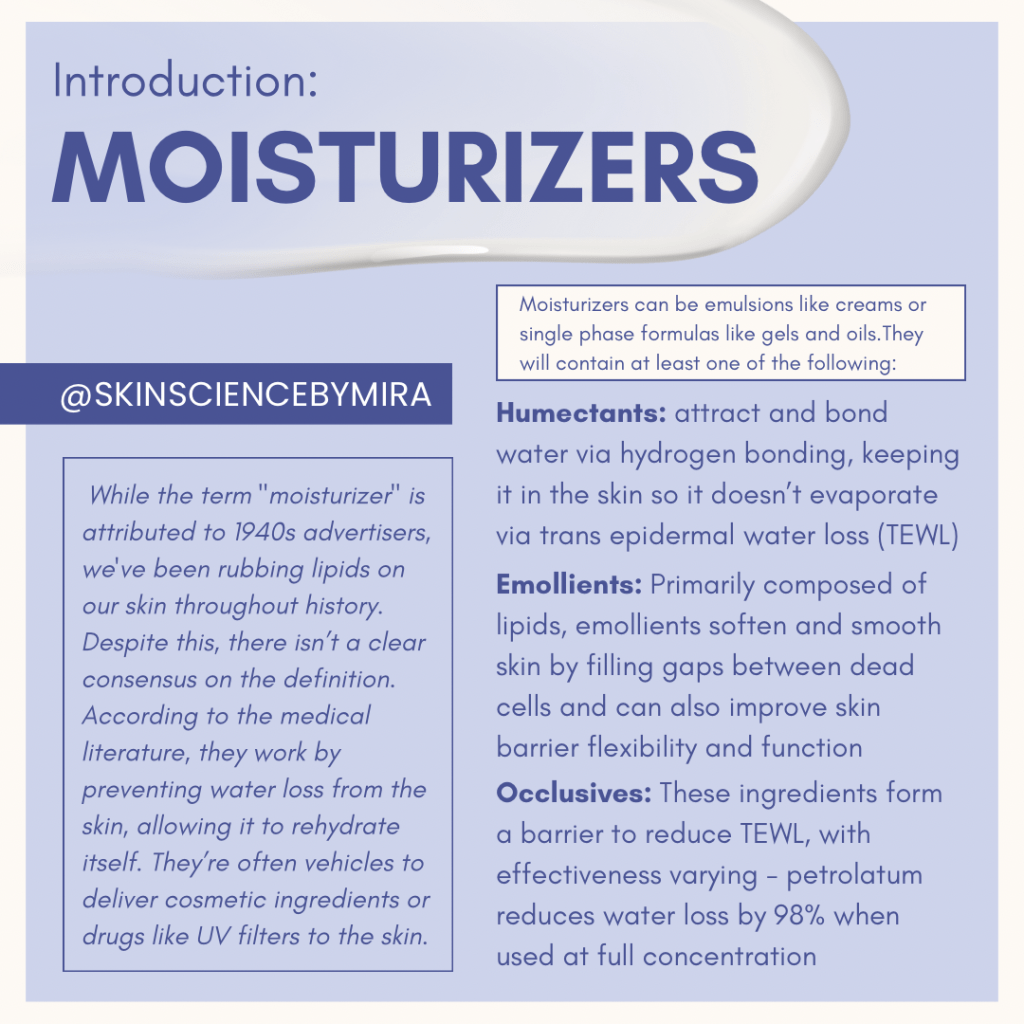
Table of Contents
1. Introduction
2. A Brief History of Moisturizers
4. The Science Behind Moisturizers
5. Types of Moisturizing Ingredients
6. Moisturizer Formulations & Textures
7. How to Apply Moisturizer for Maximum Benefit
8. Common Moisturizer Myths Debunked
Introduction
There’s a lot of misinformation online about what a moisturizer actually is and how it works. In this post, we’ll break down the science behind moisturizers and the actual definition, their formulation, and how to choose the right one for your skin.
Note: this was originally a 2022 post in my Facebook group guide that has been updated and transferred here.
A Brief History of Moisturizers
Moisturizers have been used for thousands of years. Historical records point to the use of balms and ointments in Ancient Egypt 6000 years ago and later the use of creams and oils in Ancient Greece and Rome. Their use likely began long before we can find evidence – it’s instinctive to protect and moisturize our skin.
The launch of Vaseline (petroleum jelly) first in the 1860s and then Pond’s Cold Cream in 1910 – the first moisturizer that didn’t require refrigeration – would pave the way for the modern moisturizers of today.
Dr. Albert Kligman, a pioneer in dermatology despite the ethical concerns raised on his research methods, contributed to our understanding of moisturizers, discovering the efficacy of hydrating skin before applying oily substances. This research also made way for today’s sophisticated formulations.
What is a Moisturizer
The term moisturizer was created by Madison Avenue advertisers, which is part of the reason there’s so much confusion around its meaning.
Dr. Kligman initially defined a moisturizer as “a topical product effective in relieving the signs and symptoms of dry skin.” However, this definition oversimplifies their role.
My definition based on present evidence:
“A moisturizer is a topical product used to reduce trans epidermal water loss and restore barrier structure and function, allowing the skin to rehydrate itself. Effective moisturizers typically are emulsions containing all three moisturizer categories – occlusives, humectants, and emollients. Due to emerging research, there is also an added focus on skin barrier replenishing ingredients like niacinamide, ceramides, and urea.”
The most effective moisturizers contain all three main classes of ingredients: occlusives, emollients, and humectants. We’ll break these down in the next section.
The Science Behind Moisturizers
Moisturizers work by improving skin hydration and supporting the skin barrier.
Why Skin Hydration Matters
The skin has two main layers:
- Dermis (deep layer): Incredibly water-rich as it contains 60–70% of the skin’s water supply, much of it bound within the skin. Rehydrated via circulation.
- Epidermis (outer layer): Relies on diffusion from the dermis for hydration and constant exposure to the environment causes water loss.
The stratum corneum is the top layer of the epidermis and the location of our skin barrier. Keratinocytes – the most common skin cell – have differentiated into corneocytes by the time they reach the skin surface and are technically dead if still very much biologically active. These corneocytes are filled with an intracellular keratin network and also contain the Natural Moisturizing Factor, our skin’s own humectants. In between the keratinocytes you’ll find lipids with ceramides, cholesterol, and fatty acids.
The job of the skin barrier is to keep moisture in and mitigate the damaging effects of the environment. We have layers of in-built protections like antioxidant systems, photoprotective barriers, antimicrobial peptides, and more. These protect the skin against things like UV radiation, pathogens, allergens, and also mechanical trauma. A healthy skin barrier is essential for skin health and altered barrier function has been linked to inflammatory skin disorders like acne as well.
Water is essential for the skin and carefully regulated:
- Desquamation (shedding of dead skin cells): Requires water for enzymes to break down dead skin cells.
- Natural Moisturizing Factor (NMF) production: Filaggrin proteins degrade into NMF components, which require water to function properly.
- Barrier repair: Even a 1% increase in trans epidermal water loss (TEWL) triggers lipid synthesis for repair.
A well-formulated moisturizer should:
✔ Lock in moisture and reduce TEWL
✔ Soften and protect the skin surface
✔ Restore and maintain the skin barrier
✔ Help the skin rehydrate itself
Types of Moisturizing Ingredients
Humectants: grab onto water
Humectants attract and bind water that would normally be lost through trans epidermal water loss (TEWL), keeping it in the skin.
Examples: Glycerin, hyaluronic acid, amino acids, sodium PCA, AHAs, sugars
Emollients: soften the skin
Emollients fill in the gaps between skin cells, softening and smoothing the surface. They can also improve skin barrier flexibility.
Examples: Fatty alcohols, fatty acids, esters, facial oils, phospholipids
Occlusives: create a seal
Occlusives form a barrier on the skin to prevent water loss.
Examples: Petrolatum, squalane, lanolin, dimethicone, waxes, butters
Barrier Support: strength the skin barrier
These ingredients enhance barrier function by replenishing skin lipids and NMF components.
Examples: Ceramides, niacinamide, urea, cholesterol, lecithin
Now, technically all these ingredients are moisturizers. For this reason, it isn’t actually incorrect to say that an oil, petrolatum, or hyaluronic acid is a moisturizer. The most effective moisturizers will use all three.
Moisturizer Formulations & Textures
Moisturizers are more than just “hydration.” They work by preventing water loss, restoring the skin barrier, and supporting overall skin health. Choosing the right formulation depends on your skin type and specific needs, but the best moisturizers contain a balance of humectants, emollients, occlusives, and barrier-supporting ingredients. Understanding how these ingredients work will help you make informed skincare choices.
Moisturizers come in different vehicles, affecting their texture and function:
- Gel & Gel-Creams: Lightweight, water-based, best for oily skin
- Lotions: Lightweight emulsions, good for combination skin
- Creams: Richer emulsions, suitable for dry skin
- Balms: Oil-based, thickest option, best for extreme dryness
Most moisturizers (except balms) are emulsions, meaning they contain both water and oil stabilized with emulsifiers. Water-based formulas require preservatives to prevent microbial growth.
It’s important to note that moisturizers are also used as a vehicle for cosmetic ingredients and even drugs. This means that they’re used to deliver these ingredients onto or into the skin. Example: most sunscreens use moisturizers as their vehicle and you don’t need a separate one unless your skin sort feels dry.
How to Apply Moisturizer for Maximum Benefit
- Apply as the last step in your routine (before sunscreen in the morning).
- Using a moisturizer with a hydrating toner or serum can first boost efficacy.
- If layering oils, most should go before your moisturizer unless it’s a gel.
- To reduce irritation with retinoids, moisturizers can be applied first as a buffer.
Common Moisturizer Myths Debunked
“Moisturizers add water to the skin.”
➜ Half-truth. The skin’s hydration is mainly influenced by water that is bound within its structure and adding more free water doesn’t help. Moisturizers can instead help the skin retain and rehydrate itself.
“XYZ product is only an occlusive, it needs a moisturizer underneath.”
➜ Myth. Most products labeled as “occlusives” contain emollients and humectants as well. Even if they don’t, they can still improve skin hydration as the skin has its own mechanisms to rehydrate itself.
“Oils are occlusive.”
➜ Mostly false. Oils are primarily emollients due to their branched fatty acid chains of varying lengths; only certain oils (like squalane, which is technically a hydrocarbon) have occlusive properties.
“You don’t need a moisturizer if you have oily skin.”
➜ False. Oily skin still experiences water loss and benefits from hydration and barrier support. That being said, if your skin doesn’t need it then it’s fine to skip and oily skin types may do well with just toners and serums.
“Moisturizers make your skin lazy.”
➜ False. I have yet to see any evidence of this, only a wealth of research on the beneficial effects of moisturizers on skin hydration and barrier function. While dehydration is what stimulates the breakdown of filaggrin into Natural Moisturizing Factors (as mentioned above), it seems topical humectants may influence this too.
“You need to apply moisturizer on damp skin or over a hydrating toner or serum for it to work.”
➜ False. As we’ve discussed, most well formulated moisturizers contain but humectants and even just apply an occlusive ingredient will allow the skin to rehydrate itself. Cosmetic chemist Stephen suggests that adding a hydrator may further boost efficacy but the order didn’t seem to matter nor is it needed for results.
Final Thoughts
To quote Dr. Zoe Draelos in the Cosmeceuticals book of her Procedures in Cosmetic Dermatology series, “moisturizers are true cosmeceuticals. They have the ability to profoundly alter the structure and function of the skin. Their true main role is to enhance or maintain the water content of the skin, but they are also the most efficient vehicle for delivering sun protection and other actives.”
Got a favorite moisturizer or questions? Drop them in the comments! You can also find my favorites here.


Leave a Reply